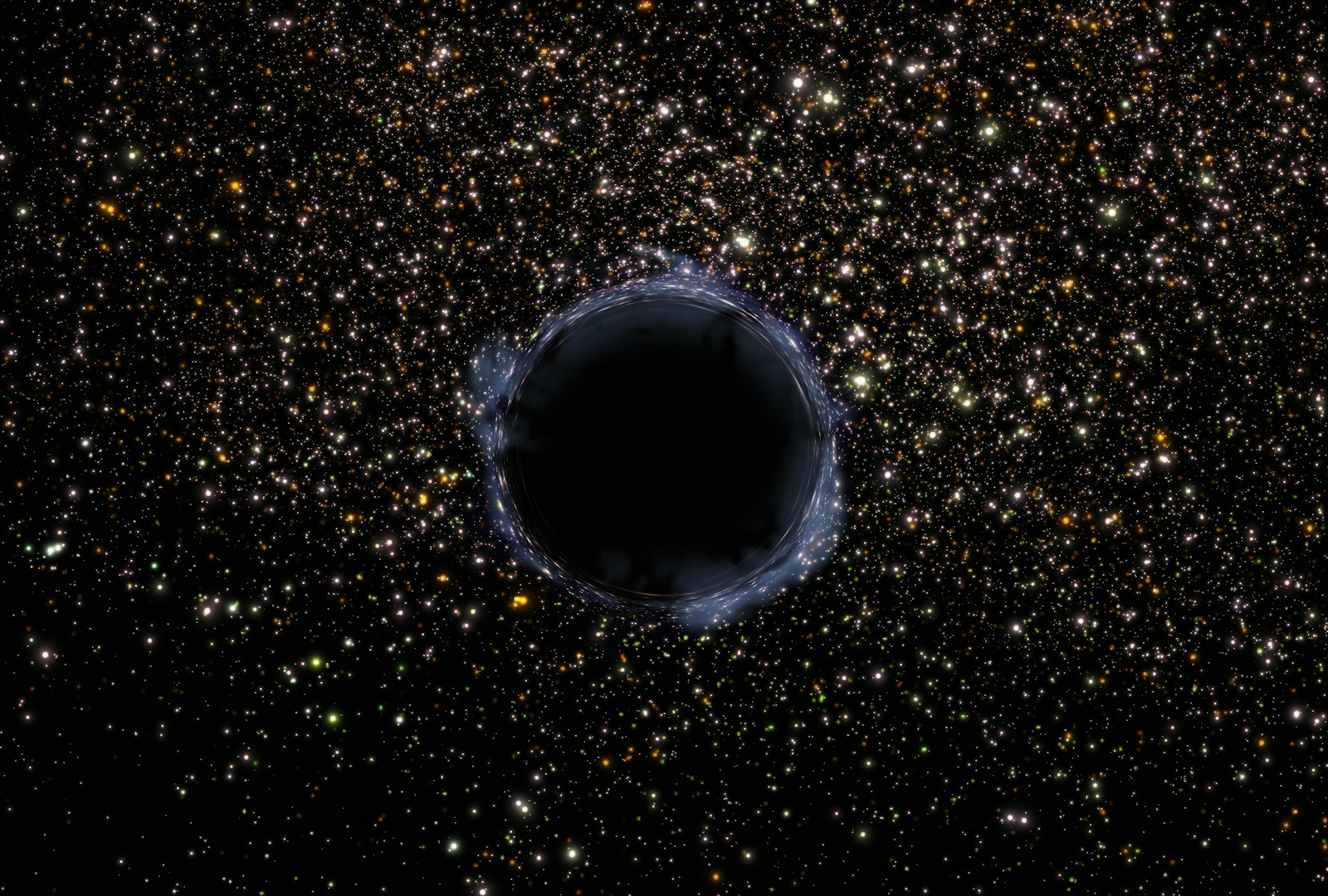

Black holes have always fascinated me with their mysterious pull and mind-bending physics. These cosmic giants challenge everything I thought I knew about space and time. Every time scientists make a new discovery about black holes the universe feels a little more thrilling and a lot more puzzling.
I can’t help but wonder what really happens beyond that invisible boundary where nothing escapes. The more I learn the more questions I have. If you’re as curious as I am get ready to explore some of the most surprising and mind-blowing facts about black holes.
What Are Black Holes?
Black holes are regions in space where gravity compresses matter into a tiny volume, creating a gravitational field so intense that nothing, not even light, escapes. I define a black hole by its event horizon, which marks the boundary where escape becomes impossible. Scientists detect black holes indirectly by observing effects on nearby objects, such as stars or gas clouds, that spiral inward and emit X-rays as they get pulled apart. I classify black holes by mass: stellar-mass (about 3–20 solar masses), intermediate-mass (hundreds to thousands of solar masses), and supermassive (millions to billions of solar masses), with examples including Cygnus X-1 and Sagittarius A* at the center of the Milky Way. Each type forms under different cosmic conditions yet all share one feature—extreme warping of space and time as predicted by Einstein’s theory of general relativity.
How Black Holes Form
Black holes originate through well-understood astrophysical processes tied to stellar life cycles or galaxy evolution. I rely on leading research to describe the distinct ways stellar and supermassive black holes form.
Stellar Collapse
Stellar black holes form from the death of massive stars. When a star exceeds about 20 solar masses, its core collapses after depleting nuclear fuel. If the remaining core mass is above 2-3 solar masses, gravity compresses it beyond neutron star density, causing a black hole to emerge. Sometimes, this collapse triggers a supernova that blows off the outer layers, while in other cases, the star collapses directly without an explosion. Factors such as the star’s metallicity—where low-metallicity stars lose less mass—and binary interactions—where a companion star can strip or add mass—alter these paths. I see evidence for stellar black hole formation in X-ray binaries and through gravitational wave detections of black hole mergers.
Supermassive Black Holes
Supermassive black holes occupy galaxy centers, including the Milky Way. Their origins trace back to the early universe, where dense gas clouds may have collapsed directly or smaller black holes merged and accreted matter over time. Masses for these giants range from millions to billions that of the Sun. I find observational confirmation in the dynamic behavior of stars orbiting galactic centers, in the energy output of quasars, and in iconic images like the Event Horizon Telescope’s capture of M87’s supermassive black hole. Their presence influences galaxy formation and growth by regulating star formation and energizing surrounding gas.
Fascinating Facts About Black Holes
Black holes constantly reshape our understanding of space and physics. I find their extreme properties both astonishing and deeply compelling.
Event Horizon and Singularity
A black hole’s event horizon marks a one-way boundary—escape can’t happen beyond it. Inside, every path in spacetime leads to the singularity, an infinitely dense core where gravity overwhelms all known physical laws. The event horizon’s escape velocity exceeds light speed, so even photons can’t get out once crossing it. At the heart, the singularity crams mass and energy into a single, dimensionless point, collapsing the fabric of spacetime.
Time Dilation Near Black Holes
Time near a black hole slows dramatically compared to distant regions, directly resulting from strong gravity. As I compare clocks, one near the event horizon ticks much slower than one farther away. This effect, called gravitational time dilation, comes from general relativity and grows near the event horizon—time nearly halts from an outside viewpoint. Any visitor watching from far away would see falling objects appear to freeze at the edge of the event horizon.
Hawking Radiation
Black holes, despite trapping light, emit faint thermal energy known as Hawking radiation. Stephen Hawking predicted this effect, where quantum fluctuations just outside the event horizon let black holes lose tiny amounts of mass and energy over time. For most black holes like Cygnus X-1 or those at galactic centers, Hawking radiation is weaker than cosmic microwave background heat, so they typically gain more energy than they emit. Only hypothetical, tiny black holes could visibly evaporate through this process, vanishing within the universe’s lifetime.
Notable Black Hole Discoveries
Recent black hole discoveries reveal how much my understanding of these objects has advanced through new technology and global collaboration. Astronomers now uncover clear evidence about black hole origins, properties, and their astonishing extremes.
First Image of a Black Hole
The first image of a black hole came in 2019, when the Event Horizon Telescope (EHT) team released an image of a supermassive black hole at the center of galaxy M87. This achievement, involving over 200 researchers worldwide, confirmed predictions from general relativity and showed the glowing gas outlining the event horizon. The EHT’s use of a global network of telescopes allowed me to see direct visual proof of a black hole’s silhouette for the first time.
Record-Breaking Black Holes
Record-breaking discoveries focus on objects with masses much greater or smaller than previously confirmed. New gravitational wave detectors identified black holes from merging stellar remnants, helping me link their spins to different formation channels such as repeated collisions in star clusters. Ongoing searches target even more massive examples, with observatories like the Einstein Telescope aiming to capture the signals from black holes billions of times the mass of the Sun. Each breakthrough helps me better understand the population, growth, and true limits of black holes across the universe.
Black Holes in Popular Culture
Black holes in popular culture appear as metaphors for anything overwhelming or consuming, often stretching far beyond scientific fact. I often see writers and filmmakers describe financial crises, lost time, or vanished objects as disappearing into a “black hole” to highlight total loss or mystery. For example, headlines sometimes claim government budgets have “black holes” when accounting gaps swallow funds without trace.
Movies and television frequently feature black holes as cosmic threats or portals to other dimensions, with titles like “Interstellar” using real astrophysical concepts but dramatizing effects for suspense. Authors borrow the event horizon concept, sometimes suggesting it’s a threshold of no return in personal, psychological, or societal contexts. While these uses capture the aura of impenetrability and mystery surrounding astrophysical black holes, they exaggerate the idea that these objects indiscriminately “suck in” everything nearby.
Black holes also fuel inspiration for visual arts and music, with artists referencing their compelling darkness or using their names to evoke existential themes. I notice music albums and band names, such as Soundgarden’s “Black Hole Sun,” draw from the concept to signify depth and complexity.
Despite these broad interpretations, real black holes possess gravity that matches any equivalent mass at distance, attracting objects only when they come close enough, rather than vacuuming everything from afar. When I encounter these cultural references, I appreciate how their usage bridges scientific curiosity with artistic imagination, reinforcing the lasting fascination with black holes across society.
Conclusion
Black holes never fail to capture my imagination. Their blend of mystery and science keeps me coming back for more questions and discoveries. As technology advances and our understanding deepens I’m excited to see what new secrets these cosmic enigmas will reveal. There’s always more to explore when it comes to the universe’s most extreme phenomena.
Frequently Asked Questions
What is a black hole?
A black hole is a region in space where gravity is so strong that nothing, not even light, can escape from it. Black holes are formed when massive stars collapse at the end of their life cycles, and are defined by their event horizon, a boundary beyond which escape is impossible.
How do scientists detect black holes if they are invisible?
Scientists detect black holes by observing their effects on nearby objects. For example, matter falling into a black hole emits X-rays, and stars or gas clouds can orbit or behave unusually near an invisible, massive object.
What are the main types of black holes?
There are three main types: stellar-mass black holes (formed from dying stars), intermediate-mass black holes (with masses in between), and supermassive black holes (millions to billions of times the mass of our Sun, found at galaxy centers).
How are black holes formed?
Stellar black holes form when massive stars exhaust their fuel and collapse under their own gravity. Supermassive black holes may form from merging smaller black holes or from large gas clouds in the early universe.
What is the event horizon of a black hole?
The event horizon is the invisible boundary around a black hole. Once anything crosses this boundary, including light, it cannot escape the black hole’s gravity.
What is gravitational time dilation near a black hole?
Gravitational time dilation means time passes much slower near a black hole compared to farther away. This is due to the extremely strong gravity near the event horizon, as predicted by Einstein’s theory of general relativity.
What is Hawking radiation?
Hawking radiation is a theoretical prediction by Stephen Hawking that black holes can emit weak thermal energy and slowly lose mass over time. This effect is extremely small for most known black holes.
Have scientists ever photographed a black hole?
Yes, in 2019 the Event Horizon Telescope captured the first direct image of a black hole at the center of galaxy M87, providing visual proof of supermassive black holes.
Why are black holes important in galaxy formation?
Supermassive black holes influence the behavior of stars and gas in galaxies, affecting galaxy growth and structure. Their presence is linked to how galaxies evolve over billions of years.
How are black holes represented in popular culture?
Black holes often appear in movies and stories as mysterious or destructive forces. While these portrayals capture the intrigue of black holes, they sometimes exaggerate their nature, showing them as indiscriminately sucking in everything nearby.